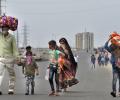
'While the poor have little say in shaping India's intellectual or public discourse, they do have a significant role in deciding political outcomes,' points out Roshan Kishore.

During the last few meetings, farmer leaders have been arranging their own lunch, snacks and beverages while refusing to have the food organised by the government.
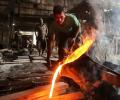
Prime Minister Narendra Modi on Friday said production linked incentive (PLI) scheme, which is aimed at boosting domestic manufacturing and exports, is expected to increase the country's production by $520 billion in the next five years. Addressing a webinar on PLI scheme, organised by Department of Industry and International Trade (DPIIT) and NITI Aayog, through video conference, Modi said the government is continuously carrying out reforms to boost domestic manufacturing. In this year's Budget, about Rs 2 lakh crore was earmarked for the PLI scheme for the next five years and "there is an expectation that the scheme would result in increasing the production by about $520 billion in the next five years", he said. He added that there is also an expectation that the current workforce in the sectors, which will avail the benefits of the PLI scheme, will be doubled and job creation will also increase.

Sitharaman also announced Rs 10,000 crore fund to support 2 lakh micro food enterprises for promoting health and wellness, herbal, organic and nutritional products.

The revival of the phytosanitary protocol with China is expected to boost tobacco exports to China and prove economically beneficial to Indian farmers.

Contentious issues such as the construction of a Ram Temple in Ayodhya, abrogation of Art 370 giving special status to Jammu and Kashmir and enactment of Uniform Civil Code have been included in the Bharatiya Janata Party's election manifesto with the party making promises on them.
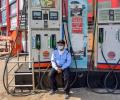
Hitting out at Prime Minister Narendra Modi over the issue of tax cuts on petroleum products, Tamil Nadu Chief Minister M K Stalin on Thursday said people were aware of the fact behind the issue and pointed out at his government effecting a Rs 3 a litre cut on petrol earlier.

At a press conference after a meeting of the party's senior leaders, K C Venugopal said the Congress will also launch a massive signature campaign in which it aims to collect two crore signatures from farmers and the poor people against farm bills.
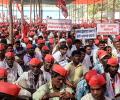
Governments must encourage micro-irrigation, use of natural manure and pesticides in a big way. Farm income can be doubled by reducing cost as much as by increasing MSP, says Sanjeev Nayyar.
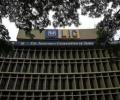
Listing of LIC will help bring in greater transparency, public participation and also deepen the equity market.

'One way of doing this could be offering credit guarantee to the banks, say 10 per cent, for fresh loans given to micro, small and medium enterprises,' observes Tamal Bandyopadhyay.

Tightening the noose around whistleblower IAS officer Ashok Khemka, Haryana government is preparing a second charge sheet against him for alleged low sale of wheat seeds during his tenure in Haryana Seed Development Corporation as its managing director from October 15, 2012 to April 4 this year.

The issue is expected to be raised by some other European nations during the G-20 meet to be held in Seoul in November, a senior official in the agriculture ministry said.
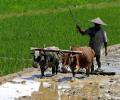
States need to create alternative marketing structures for farm produce since middlemen also provide vital services that are otherwise unavailable to the farmer.

Adopting a firm stand, India has said that the success of the WTO negotiations would depend on the willingness of the developed countries to scale down agricultural subsidies and allow market access to developing nations.

India's economy could prove to be the "most resilient" in the subregion of South and South-West Asia over the long term, according to a report by the UN, which says a positive but lower economic growth post COVID-19 pandemic and the country's large market will continue to attract investments. The report titled 'Foreign Direct Investment Trends And Outlook In Asia And The Pacific 2020/2021', and compiled by United Nations Economic and Social Commission for Asia and the Pacific (UNESCAP), stated that inward FDI flows to South and South-West Asia slightly decreased by 2 per cent in 2019, from $67 billion in 2018 to $66 billion in 2019. The growth, however, was mainly driven by India, which accounted for 77 per cent of the total inflows to the subregion and received $51 billion in 2019, up 20 per cent from the previous year.
The race to get a New Umbrella Entity (NUE) licence for digital payments may get crowded. As many as six consortiums are said to be in the fray to apply for an NUE licence, which would create a for-profit National Payments Corporation of India (NPCI)-like body for retail payments. A consortium led by Financial Software and Systems (FSS), a leading provider of payment products and payment processor, is in talks and may file an application to the RBI for an NUE license, said sources aware of the development. The other constituents of this group include Indian Bank, Central Bank of India, India Post Payments Bank, National Bank for Agriculture and Rural Development (Nabard), and a few small finance banks.

Pushed by rising prices of essential kitchen items, the retail inflation rose to an eight-month high of 7.34 per cent in September, making the RBI's task to push growth by reducing the interest rate even more difficult in coming the days. The Consumer Price Index (CPI)-based inflation was 6.69 per cent in August and 3.99 per cent in September 2019. Inflation has been hovering above 4 per cent since October 2019.
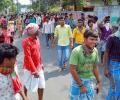
As the world awaits the end of the global pandemic, rural Bengal might be witnessing a recession unfolding in bits and pieces. With factories and tea gardens closing down, agricultural income falling and storm Aila ravaging a large part of deltaic West Bengal in 2010, migration gradually became a norm.
The Reserve Bank of India on Wednesday retained the economic growth projection for the current financial year at 10.5 per cent, while cautioning that the recent surge in COVID-19 infections has created uncertainty over the economic growth recovery. In its last policy review, the RBI had projected a GDP growth rate of 10.5 pc for FY'22. Taking various factors into consideration, it said, "the projection of real GDP growth for 2021-22 is retained at 10.5 per cent consisting of 26.2 per cent in Q1, 8.3 per cent in Q2, 5.4 per cent in Q3 and 6.2 per cent in Q4."
Why are investors gung-ho about State Bank? asks Tamal Bandyopadhyay.

Cheap milk prices, rising fodder cost and the difficulties in buying new cattle and selling old ones on account of cow vigilantism have cast a triple shadow on this sunshine sector in Indian agriculture, reports Sanjeeb Mukherjee.

Indians want change and progress. They should be willing to accept tough decisions, says Sanjeev Nayyar.

With certain quarters demanding privatisation of public sector banks in the aftermath of the alleged fraud at Punjab National Bank (PNB), Economic Advisory Council to the Prime Minister chairman Bibek Debroy tells Sanjeeb Mukherjee, Ishan Bakshi and Indivjal Dhasmana that reducing government equity even to zero would not mean giving up of government control over these banks.

'We didn't expect the film to be recognised at this level; we focused on making an honest and simple film.' 'We didn't have any expectations even like being appreciated at festivals.'

'Government is saying that I will not be responsible for ensuring you get MSP but traders and large corporate will be responsible. 'India now is the only country that is saying such things'

'India could become the newest Asian tiger under Modi's dynamic leadership. Modi could become the Nehru of the 21st century, and re-establish a new Tryst with Destiny, by stating once and for all that Mera Bharat Mahaan is and will always be a truly secular and inclusive democracy in the best spirit of Bharatiya-tva,' says Ram Kelkar, offering an NRI view of the Modi triumph.
The two countries agree to work together on the scientific, technical, and policy aspects of biofuels development, production, and use. These areas include biomass production and sustainability, conversion technologies, bio-based products, and rural development strategies.

Official celebrations in most states were restricted to unfurling of the national flag and chief ministers and governors addressing the people, with fewer guests in attendance.

The government plans to borrow Rs 4.17 lakh crore (Rs 4.17 trillion) from the market. Last year it had borrowed Rs 4.47 lakh crore (Rs 4.47 trillion).

What some of us think are strong, bold and firm decisions are cruel, harsh and unwanted for others. This is what we need to consider when we look at what has happened with the farm laws, asserts Aakar Patel.

Asked for China's comments on India not joining the RCEP deal over concern of cheap Chinese products potentially harming its domestic industry, Chinese foreign ministry spokesman Geng Shuang told the media in Beijing on Tuesday that China welcomes India joining the deal.

Indian economy is likely to rebound with an 8.9 per cent growth in the fiscal year beginning April 2021 after economic activity showed significant improvement in the last quarter, IHS Markit said on Friday. The National Statistical Organisation (NSO) on Thursday predicted that the economy will contract 7.7 per cent in the current financial year ending in March, the worst performance in four decades.

India continues to apply import quotas on marble.

'If we do not burn the residue, wheat sowing will be delayed and that will ultimately affect the yield'

'The economic impact of this lockdown is evidently huge.' 'Its impact on the livelihood of vulnerable sections of the society is immeasurably bigger,' observes Mahesh Vyas.
The annual earnings of a non-executive chairman of a PSB is capped at Rs 10 lakh, inclusive of fees for attending board meetings. This is way below the compensation of the chairman of any private bank, reveals Tamal Bandyopadhyay.

'It may take two years for the economy to return to normal.' 'We should ensure that the vulnerable do not dig into their savings or give up their assets because that will set them back by several years.'
The PM said that the Union Budget will accelerate the economic growth, financially empower every citizen and strengthen the foundation of the economy in the new decade.
